
Exploring use cases of 5G NB-IoT NTN: Push to talk, two-way messaging and firmware update

Description
While known for its use in IoT applications, 5G Narrowband-IoT NTN holds an unexplored potential for functionalities such as push-to-talk, two-way messaging, and firmware updates via satellites. Join our webinar to gain insights into the technical requirements and use-case feasibility.
In this webinar, our Research Engineer, René Brandborg will showcase how standard 5G NB-IoT NTN can support essential use cases by sharing results of our feasibility analysis and simulations. Get a deep understanding of the possibilities and challenges involved, enabling you to make informed decisions regarding implementation and deployment strategies.
To underline the vast business potential, Sales Executive Raphaela Oliveira Teixeira will shed light on the commercial advantages of integrating 5G NB-IoT NTN services to unlock new market opportunities and competitive advantages.
Watch our webinar to gain valuable insights into implementation and deployment strategies, empowering you to harness the full capabilities of NB-IoT for enhanced communication services.
Agenda
Welcome and introduction
What’s the potential of 5G Narrowband IoT NTN use cases?
Technical requirements of push to talk, two-way messaging and firmware updates
Use-case feasibility with 5G NB-IoT in various satellite configurations
What does it take to launch a 5G NTN service?
Live Q&A session.
Presenters


Questions and Answers
Questions and answers from the Q&A section of this webinar.
A single HARQ process was considered and the evaluation was performed for both LEO, MEO and GEO setups for both a transparent architecture and a regenerative “full eNB onboard” architecture. The resulting ‘Total exchange times’ would be better overall by utilizing Dual HARQ or disabling HARQ (Rel18) – however single HARQ is the mandatory Rel17 feature, so it is of particular interest.
The performance improvement with dual HARQ and HARQ disabling are relatively greater for MEO, GEO and in particular applying the transparent architecture, which suffer a higher impact of propagation times.
The number of unicast PTT messages that can be performed at the same time is a function of the recorded message lengths.
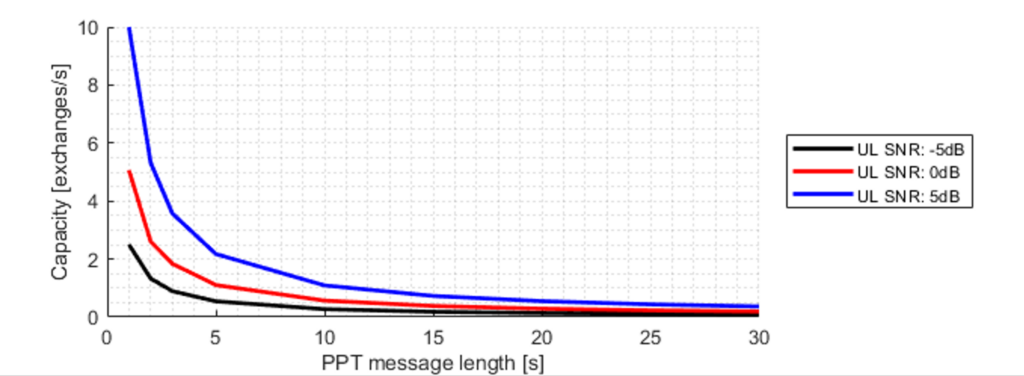
Here, we can see that in poor link conditions (DL -11 dB, UL -5 dB) we can achieve 0,4 exchanges / s of a 5s voice message.
If we consider that messaging takes place in pairs, this means that if it takes an aggregated 10 seconds to record and listen to a message, then a minimum of 4 such pairs can be active at once at any time.
Utilizing broadcasting functionality (SC-PTM) one can obtain much higher scalability on the receiving end. Then a minimum of >4 groups of UEs can take part in a PTT session (assuming some tokenization of the “speaker”)
NB-IoT Rel17 has no protection against GNSS jamming. If the UE is not aware of its position, then the UE is not allowed to transmit. However, UEs that know their position before a GNSS jamming takes place, may transmit for as long as their GNSS position is valid.
In release 18 there are new features introduced, which would allow UEs to potentially extend the validity of their uplink transmissions by having the eNB adjust the TA and frequency shifts of the UE during an exchange.
We’re currently supporting the implementation of orbital testing together with our clients, contributing our expertise to various projects. For additional information and updates on project milestones, we invite you to subscribe to our newsletter.
The number of satellites required in LEO to obtain the total exchange times given in the presentation would be 1, but this counts only for message exchanges that can take place within the coverage area of a single satellite and during the time with line-of-sight and sufficient link quality. It would require in the order of 100-1.000 satellites to provide continuous global coverage depending on the satellite complexity and payload.
Yes, two-way messaging is an application, which is fully supported using mandatory NTN NB-IoT features.
A broadband solution requires a more costly UE implementation for one, but looking beyond the cost, NB-IoT has the unique feature of very narrowband channels, which enables increasing the power-density of received signals. Being able to increase the power density is important for IoT in terrestrial networks to enable a large coverage area was for power-limited UEs. In NTN the link-budget is challenged by the nature of satcom where the distance is even higher so the importance of this NB-IoT is renewed.
The two technologies support different use-cases and while NR NTN may be able to provide the QoS (and more) required for IoT use-cases, it lacks for example the very narrow band transmissions that NB-IoT is capable of. Broadband transmissions and higher protocol complexity sets higher requirements for the receiver in the UE by requiring an antenna with higher gain and a more complex receiver, which brings up the cost of the UE. Furthermore, NB-IoT NTN is less complex and more robust also working under link conditions where NR NTN would fail, but it is not capable of delivering the QoS required for real-time voice of high quality, or video streaming. So essentially the two technologies are seen as complementary to handle a wide spectrum of use-cases and are likely to coexist in the future.
More webinars
Subscribe to the Gatehouse Satcom newsletter
Get news and insights from the world of 5G NTN.