5G IoT at 10 Mbit/s, and what it means over satellite
eRedCap, short for enhanced Reduced Capability, is a 5G device class defined by 3GPP in Release 18. It takes the Release 17 RedCap device and caps its peak data rate on a terrestrial network at 10 Mbit/s in both directions, with an option to narrow the data part of the modem to around 5 MHz of bandwidth. The purpose is a cheaper, simpler, lower power 5G modem for products that were never going to use 100 Mbit/s.
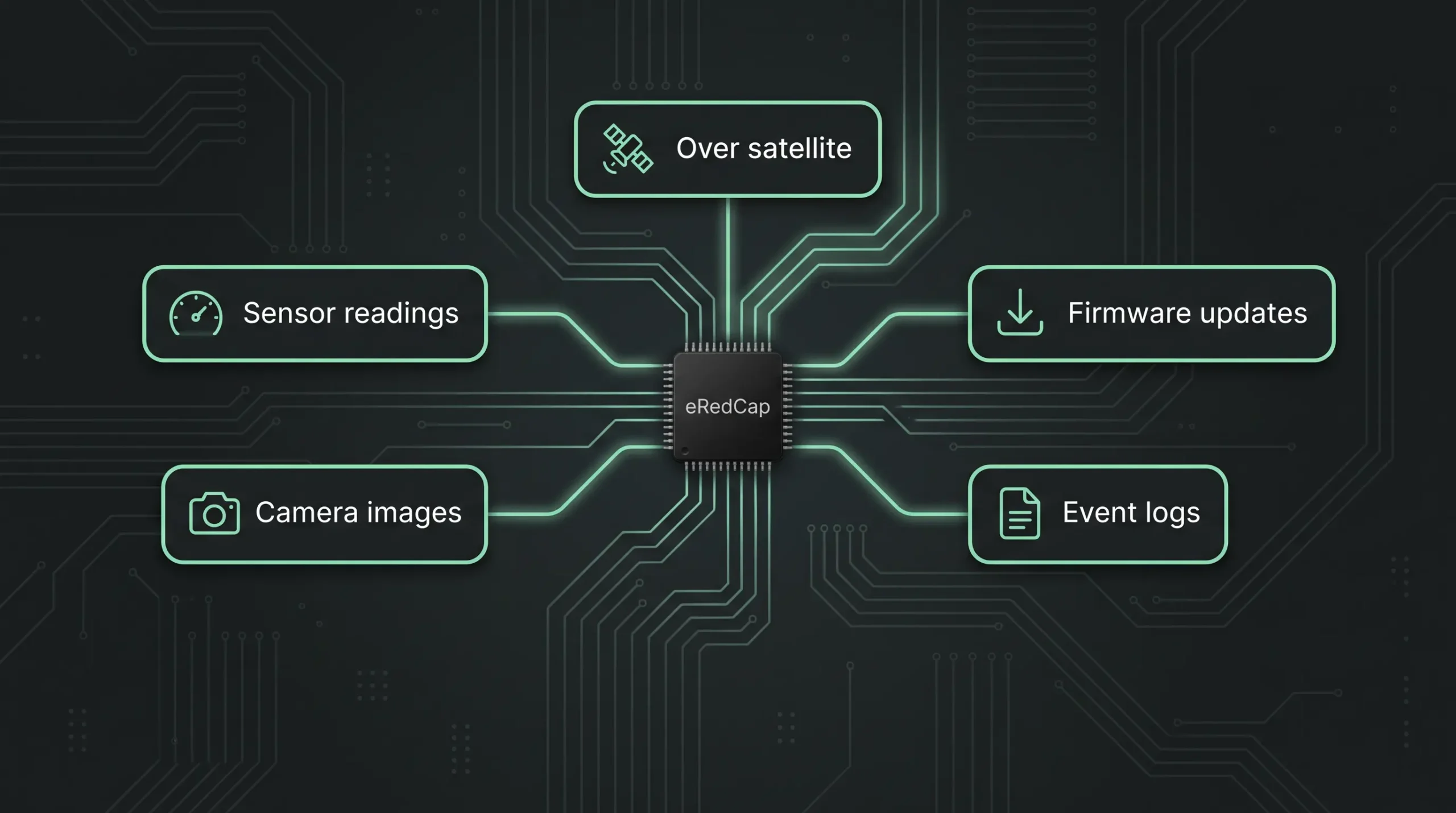
That trade is why the device class matters to satellite. Very few satellite IoT applications need tens of megabits. What they need is a device cheap enough to deploy in numbers, frugal enough to run for years, and capable of more than a handful of bytes per message. eRedCap sits exactly there: one radio, at roughly the price of a 4G module, that can send a sensor reading today and carry a camera image or a software update tomorrow. That combination opens product categories satellite IoT has not been able to serve.
The term is barely covered online today. The device class is young, the first chipsets are in testing rather than in products, and almost everything written about it assumes a terrestrial network. That assumption is the one worth examining. The first half of this piece is what 3GPP specified. The second half is what changes when the radio cell sits on a satellite instead of a tower, because that is where the device class has to prove itself.
Where eRedCap came from
3GPP introduced RedCap in Release 17 under the working name NR-Light, to bring a 5G NR device down to something that offers similar performance to LTE Cat-4, the mainstream 4G class at about 150 Mbit/s downlink, at lower cost and longer battery life, while staying inside the 5G standalone ecosystem. A RedCap device is limited to 20 MHz of bandwidth in FR1, the frequency range below 7 GHz, can be built with a single receive antenna instead of two, has 64QAM as its mandatory maximum modulation with 256QAM optional, and cannot use carrier aggregation or dual connectivity. In FDD bands, half duplex operation is the baseline and full duplex is the option, which lets a design drop the duplexer from the bill of materials.
Peak rate depends on how far a vendor takes those options. On a terrestrial network, a fully equipped RedCap device reaches about 226 Mbit/s downlink and 120 Mbit/s uplink in a 20 MHz FDD carrier, while the simplest single antenna design sits nearer 85 Mbit/s downlink and 90 Mbit/s uplink. Ericsson puts the modem in the simplest RedCap device at about one third the complexity of the modem in the simplest ordinary 5G NR device.
That is still more capability than much of the IoT market needs. The volume class in cellular IoT is LTE Cat-1 and its single antenna variant Cat-1 bis, roughly 10 Mbit/s down and 5 Mbit/s up, at a fraction of a RedCap module price. Counterpoint Research, which tracks module shipments, reported that Cat-1 bis passed half of global cellular IoT shipments for the first time in the second quarter of 2026. RedCap was aimed at Cat-4, near the top of the IoT range. The volume sits further down, and a 5G replacement for it must be cheap first and fast second.
eRedCap is that replacement, aimed at Cat-1 rather than Cat-4, in low and mid bands only. The 10 Mbit/s cap is mandatory. The bandwidth reduction is optional: the radio front end still covers 20 MHz while data transmission is limited to 25 resource blocks at 15 kHz subcarrier spacing, or 12 at 30 kHz, roughly 5 MHz, and that is where most of the cost and power saving comes from. Release 18 also relaxes the response time the device has to meet in the attach procedure and raises the maximum sleep between check-ins to about 2.91 hours in the fast resume state that 5G calls RRC inactive.

What changes when the cell is on a satellite
Everything above is written for terrestrial networks. Over a satellite link the same parameters behave differently.
Start with the link budget. A single receive antenna is the largest cost saving in a RedCap class design and also its largest penalty. Ericsson Research measured the step from two receive antennas to one at about 3.2 dB on the downlink data channel at 2.6 GHz, and 3.8 dB for a single antenna device in a rural 700 MHz case, with the loss of receive diversity on top of that. Three dB is half the received power, so the device arrives at the link with less than half the effective signal quality of a two-antenna design. Those are terrestrial measurements and they set the size of the handicap rather than predicting the satellite case. In an NTN link budget, where elevation angle, satellite EIRP and fade margin are already fought over in single digits of dB, a device class that starts several dB down has to earn its place through satellite antenna gain and scheduling. Putting numbers on that for a given constellation is ordinary link budget work, and it is what our feasibility studies produce.

The spectrum shape happens to fit. The FR1-NTN bands are narrow next to terrestrial bands. Band n254 has 16.5 MHz in each direction, n255 has 34 MHz and n256 has 30 MHz, with channel bandwidths running from 3 MHz up to 20 MHz depending on band and subcarrier spacing. Mobile satellite service spectrum, the frequencies licensed for direct satellite to device links, is scarce and expensive. An eRedCap device, designed around 5 MHz of data bandwidth, is a closer match to the spectrum that exists over satellite than a 20 MHz RedCap device is.

Timing, delay and Doppler still decide whether the device connects. None of this is specific to eRedCap. It applies to any device class arriving in NTN. The device corrects for distance and motion before it transmits, using its GNSS position and the satellite orbit data the network broadcasts, and the network shifts its scheduling so it does not expect an answer before one can physically arrive. The random access response window, which the network configures and the device monitors, has to be stretched: terrestrial NR lets the network configure at most 10 ms of it in licensed spectrum, while a GEO cell can spread arrival times across the cell by up to 10.3 ms on its own. Contention resolution timers, preamble transmission counts, power ramping and PRACH formats all need NTN configuration, and HARQ, the retransmission mechanism, must account for round trip times of half a second or more in GEO.

This is why we treat NTN as system behavior rather than a radio problem. A device can be fully compliant with the eRedCap capability set and still fail to attach over a satellite link because a timer was set for a terrestrial cell.
The same caution applies to data rate. The 10 Mbit/s is a device processing ceiling defined for terrestrial deployment. Over a satellite the achievable rate is set by the link budget. 3GPP’s own NTN study, TR 38.821, budgets a handheld class terminal at 200 mW and 0 dBi per antenna element (Table 6.1.1.1-3) and reports the resulting carrier to noise ratios in Table 6.1.3.3-1, where the S-band uplink to a GEO satellite sits around 11 to 16 dB below the noise, to be recovered by coding and repetition rather than by raw rate. The device class raises what the modem can process. It does not change the satellite EIRP, the device antenna, or the distance.

“The interesting thing about eRedCap over satellite is that one device, at roughly the price of a 4G module, could send a sensor reading today and send video or take a firmware update tomorrow, on the same radio. That opens product categories that satellite IoT has not been able to serve.”
Peter Mariager, CTO, Gatehouse Satcom
Where 3GPP stands on RedCap over satellite
Release 19 is complete. The functional freeze came in September 2025, protocols were declared stable in December 2025, and the RAN4 performance work finished in March 2026.
Release 19 includes the NR NTN Phase 3 work item, and one of its published objectives is to support RedCap UEs with NR NTN operating in FR1-NTN bands. That objective names RedCap. The requirements go further than the objective does: the Release 19 satellite access specification, TS 38.101-5 version 19.6.0, carries clauses written for (e)RedCap, including a reference sensitivity clause specific to eRedCap in 7.3I.3 and an applicability clause in 8.2.1.1.4 that requires the eRedCap capability together with the NTN capability. Reference sensitivity for these devices is defined in bands n254, n255 and n256.
So, the position is firmer than the work item title suggests. RedCap over NR NTN in FR1 is specified, and the satellite RF and performance requirements extend to eRedCap as well. UE conformance test coverage for (e)RedCap in existing NTN bands is being added in Release 20, which is the honest marker of where the ecosystem actually is.
Where the ecosystem stands, Q4 2026

No eRedCap chipset has been announced as commercially available. Altair Semiconductor, which announced the ALT1550 in January 2026 under its former name Sony Semiconductor Israel and spun out of Sony in April 2026, still describes the part as being in advanced silicon testing. Sequans reports first samples of its Calliope 3 eRedCap chip. Both are terrestrial parts. Terrestrial RwedCap is further along: GSA counted 43 operators in 28 countries investing in RedCap in its September 2026 update, though the largest volume device so far is a smartwatch rather than an industrial sensor.
Forecasts should be read as forecasts. ABI Research expects 80 million cumulative RedCap module shipments between 2024 and 2029, 71 percent of them eRedCap, at 10 to 15 US dollars per module against around 50 dollars for a 2024 RedCap module.
What it means if you are planning satellite IoT
Two questions decide whether eRedCap belongs in your plan.
What does the payload actually need? NB-IoT over NTN is built for short messages. Our own FAQ puts the GEO physical layer at roughly 250 kbit/s downlink and 22 kbit/s uplink per transport block, with end-to-end application throughput below that once the procedural delays are counted. That is the right tool for smaller data sets, such as a meter reading or a position report. Once the product needs to move a detailed image or a software update, the question becomes which device class, and which link budget can carry it.
What is the link budget at the worst elevation you will accept? A device class that saves cost by removing a receive antenna spends that saving in dB, and whether the satellite can pay it back is a feasibility question you can answer before any hardware exists.

How Gatehouse Satcom fits
We build the software foundation for 5G NTN systems in both families this piece compares, NB-IoT and New Radio. On the NB-IoT side that is an eNodeB, a reference UE, and validation platforms used to qualify devices and networks against satellite conditions. On the New Radio side it is a gNodeB and demonstrator work. Around both, we run feasibility studies that answer link budget, capacity and procedural timing questions before anyone commits to hardware.
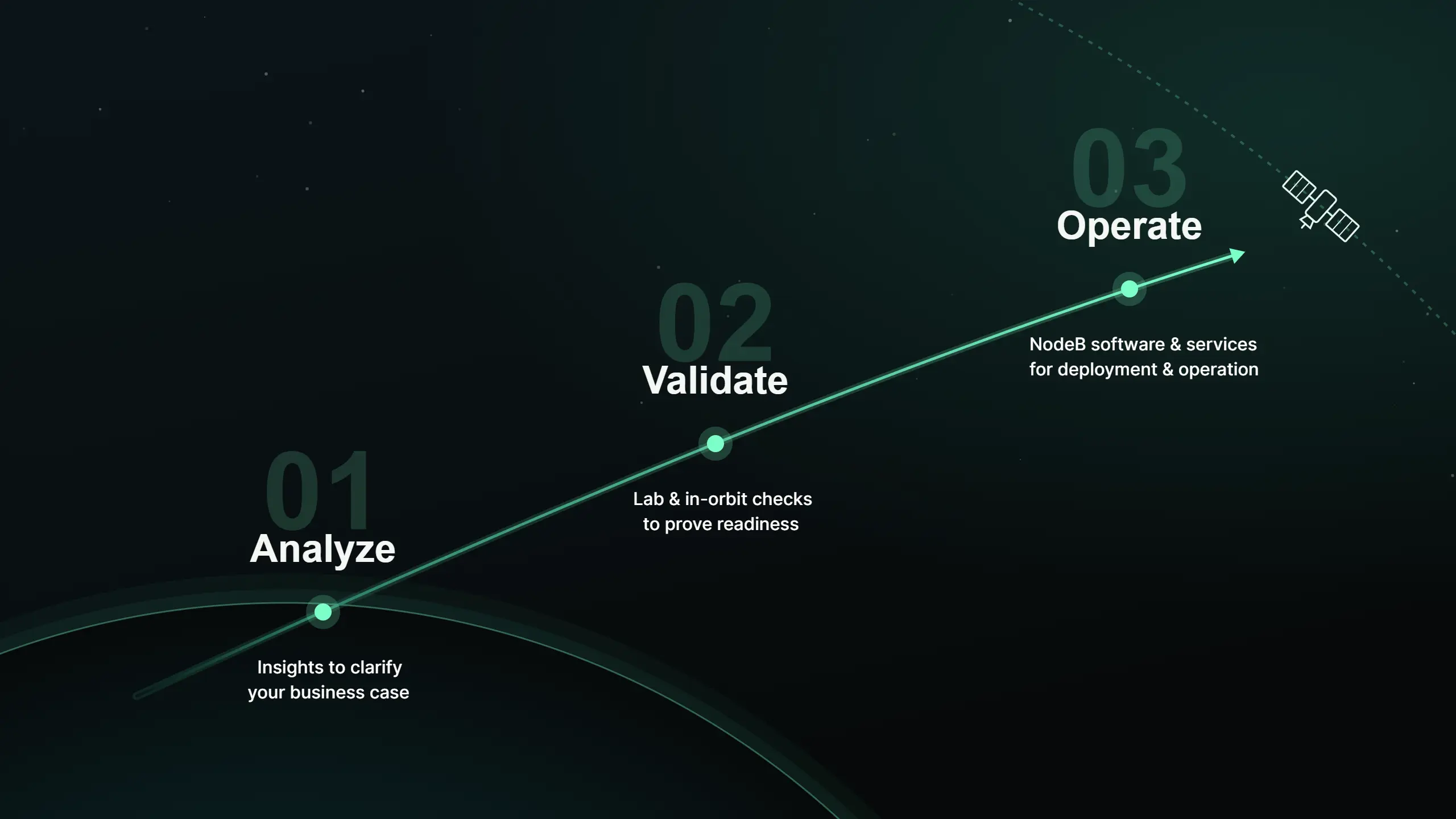
That is also how we look at eRedCap. Analyze the link budget and the access procedure, validate against emulated satellite conditions, then operate. We follow the Release 19 and Release 20 work on reduced capability devices over NTN and will publish what we learn as the standard and the silicon catch up with each other.
Both questions above are answerable now, before any hardware exists. That is what a feasibility study from us delivers: link budget, capacity and procedural timing for your orbit, your spectrum and your device assumptions, as numbers you can base a decision on. Send us the constellation and the payload you have in mind, and we will be happy to talk through your requirements.
eRedCap at a glance
| Parameter | Value |
|---|---|
| Full name | Enhanced Reduced Capability NR, also written eRedCap |
| Defined in | 3GPP Release 18, work item NR_redcap_enh |
| Peak data rate | 10 Mbit/s downlink and uplink, in the LTE Cat-1 ballpark. A terrestrial device capability ceiling, not a satellite throughput figure |
| Data channel bandwidth | Optional reduction to 25 resource blocks at 15 kHz subcarrier spacing or 12 at 30 kHz, roughly 5 MHz, with the radio front end still covering 20 MHz |
| Frequency range | Low and mid-bands only, no FR2 |
| Receive antennas | The standard allows 1 or 2, inherited from RedCap. The low cost build uses one, which costs roughly 3 to 4 dB on the downlink data channel in terrestrial measurements. How much receive diversity is lost with the second antenna depends on the channel, and over an open sky satellite link, which is mostly line of sight, the diversity gain is smaller than in terrestrial multipath |
| Duplex | Half duplex FDD is the baseline in FDD bands, full duplex is the option |
| Maximum modulation | 64QAM mandatory, 256QAM optional |
| Carrier aggregation, dual connectivity | Not supported |
| Power saving | One extra slot between the random access response and the device reply, and an eDRX cycle of up to 2.91 hours in RRC inactive state |
| Segment it replaces | LTE Cat-1 and Cat-1 bis, at about 10 Mbit/s down and 5 Mbit/s up |
| NTN status | Release 19 specifies RedCap over NR NTN in FR1-NTN bands. The satellite RF and performance requirements in TS 38.101-5 v19.6.0 extend to eRedCap, in clauses 7.3I.3 and 8.2.1.1.4. UE conformance test coverage for (e)RedCap in NTN bands is being added in Release 20 |
| FR1-NTN bands | n254 (16.5 MHz in each direction), n255 (34 MHz), n256 (30 MHz). Channel bandwidths from 3 MHz to 20 MHz depending on band and subcarrier spacing |
| Silicon status, October 2026 | Nothing commercially available. Altair Semiconductor (formerly Sony Semiconductor Israel) announced the ALT1550 in January 2026 and reports it in advanced silicon testing; Sequans reports first samples of its Calliope 3 eRedCap chip. Both are terrestrial parts |
For comparison, not eRedCap figures. The device classes eRedCap sits between.
| Device class | What it does |
|---|---|
| RedCap (Release 17), terrestrial | Up to 20 MHz: About 226 Mbit/s down and 120 Mbit/s up for a fully equipped FDD device, nearer 85 Mbit/s down and 90 Mbit/s up for the simplest single antenna design. Aimed at the LTE Cat-4 segment |
| NB-IoT over NTN, GEO | About 250 kbit/s down and 22 kbit/s up at the physical layer per transport block, with end-to-end application throughput well below that once procedural delays are counted (Gatehouse Satcom FAQ) |
| LTE Cat-1 and Cat-1 bis, terrestrial | About 10 Mbit/s down and 5 Mbit/s up. The volume class in cellular IoT today, and the segment eRedCap is built to replace |
Frequently asked questions
What can a 10 Mbit/s device actually do?
Plenty, for an IoT product. On a terrestrial network a five-megabyte firmware image moves in a few seconds at that rate, and the same device can carry images, logs and batched sensor data rather than a few bytes of telemetry. It is a poor fit for continuous high-quality video. Over a satellite link, what the device actually achieves is set by the link budget rather than by the device class.
Is eRedCap the same as RedCap?
No. RedCap is the Release 17 device class limited to 20 MHz. eRedCap is the Release 18 version of it, capped at 10 Mbit/s, with an option to limit data transmission to about 5 MHz of the device baseband. eRedCap is cheaper and slower, and it is aimed at a different segment.
Does eRedCap work over satellite?
Release 19 specifies RedCap over NR NTN in FR1-NTN bands, and the Release 19 satellite RF and performance requirements extend to eRedCap as well. No eRedCap silicon is shipping yet, and UE conformance test coverage for these devices in NTN bands is being added in Release 20, so treat it as specified rather than available.
Is eRedCap a replacement for NB-IoT?
No. They serve different purposes and payload sizes. NB-IoT over NTN carries short messages at very low rates and very low power. eRedCap targets applications that need more capacity than that, which is well beyond what NB-IoT is built for.
When will eRedCap devices be available?
Silicon was announced in early 2026 and first samples exist. Module availability in volume comes later, and forecasts put the bulk of shipments toward the end of the decade.