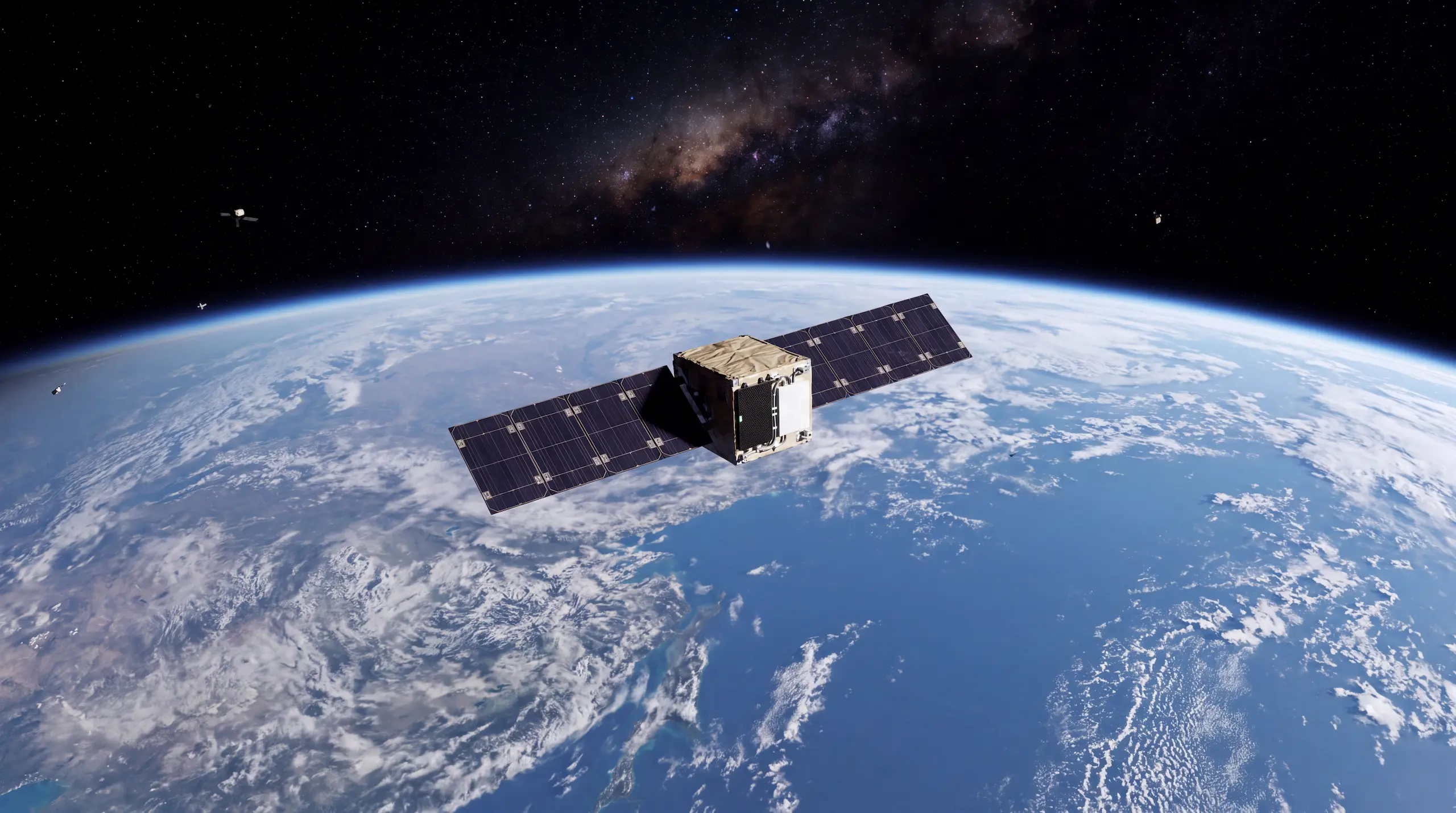
We ran 5G NR NTN and NB-IoT NTN concurrently through one emulated satellite channel. Both links came up and ran end to end.
Each air interface is specified on its own. What isn’t specified is what happens where the two share resources, and that’s what we wanted to see.
An NR UE and an NB-IoT UE sit on the same trunk. The composite signal goes through a hardware channel and orbit emulator running a GEO scenario from a TLE, applying delay, Doppler, fading, noise and path loss to both carriers at once. At the gateway the carriers split into a Gatehouse Satcom gNodeB and a Gatehouse Satcom eNodeB. It’s cabled, so nothing radiates. The scenario sits at roughly 25 degrees elevation, which puts the slant range near 39,000 km and the one way delay near 130 ms per hop.
Both carriers ride the same trunk, so they see the same channel. Same delay, same Doppler, same fading. When the two behave differently, that difference belongs to the air interface and not to the test conditions. That’s why we built a composite signal instead of running two benches.
The part that isn’t in the standard
There’s a composite signal to build, with carrier placement and relative power to settle. One ephemeris and timing source has to feed two different compensation schemes. Two timer regimes run against the same round trip. And a single ground segment has to serve a low duty cycle IoT class alongside a broadband class.
The standard describes each air interface on its own, so none of this appears in it. It’s integration work, and it’s where we’re putting lab time.
What it opens up
IoT and broadband usually arrive as two builds, with separate ground infrastructure and separate business cases behind them. One platform carrying both makes that a single asset instead of a choice between two markets.
It also puts the sequencing in the operator’s hands. An NB-IoT service can go live first, with NR added on the same platform as devices arrive.
That’s the case we’re building, and it needs more than one run to hold. Next we want it against a real RF front end, with the power and thermal constraints a payload imposes, and with numbers we can publish.
What’s next
If you’re working on multi-service satellite networks, from the operator, device or integrator side, we’d like to compare notes on what you’re seeing. Drop us a line in the contact form and we’ll reach out.