A medida que la demanda de conectividad global sigue creciendo, la ampliación de la tecnología 5G más allá de las redes terrestres se ha convertido en una parte cada vez más importante del panorama de las telecomunicaciones. La tecnología 5G por satélite se considera ahora un complemento práctico de la infraestructura terrestre, ya que permite la cobertura en zonas remotas, rurales y de difícil acceso, donde las redes terrestres siguen siendo limitadas.
In recent years, standardization efforts within 3GPP have moved 5G Non-Terrestrial Networks (5G NTN) from concept toward early implementation. This article explains the basics of 5G for satellites, what 5G NTN is, which satellite constellations can be used, and the key challenges that continue to shape satellite-based 5G deployments in 2026.
TL;DR
- 5G NTN brings satellites into the 5G system defined by 3GPP, extending coverage rather than replacing terrestrial networks. Standardized support began with Release 17.
- Orbit altitude sets the trade-offs. LEO (550 to 1,200 km) gives low latency but fast motion, strong Doppler, and short visibility windows. GEO (35,786 km) gives wide coverage but around 240 ms round-trip delay.
- 3GPP defines the mechanisms for timing, Doppler correction, and satellite handover. It does not define how to tune them for a specific orbit.
- That tuning is where conformance and stable operation diverge. A standards-compliant system can still fail over a real constellation if its settings are not matched to the orbit.
- Closing the gap means validating against realistic orbital conditions, not just confirming protocol behavior at a single operating point.
¿Qué es 5G NTN?
5G NTN, abreviatura de 5G Non-Terrestrial Networks (redes no terrestres 5G), se refiere a la integración de las comunicaciones por satélite en el sistema 5G, tal y como lo define 3GPP. En lugar de sustituir a las redes móviles terrestres, 5G NTN diseñado para ampliar la cobertura 5G permitiendo que los satélites participen como parte de la arquitectura general de la red.
In practice, a 5G NTN system combines satellite constellations, ground-based network elements, and standardized 5G protocols. This enables user devices to connect via satellite while remaining aligned with the same core network, interfaces, and service principles used in terrestrial 5G deployments.
Since the introduction of NTN support in 3GPP Release 17, and its continued evolution in subsequent releases, the focus has increasingly shifted from feasibility toward performance, interoperability, and deployment realism.
¿Qué constelaciones de satélites se pueden utilizar para 5G NTN?

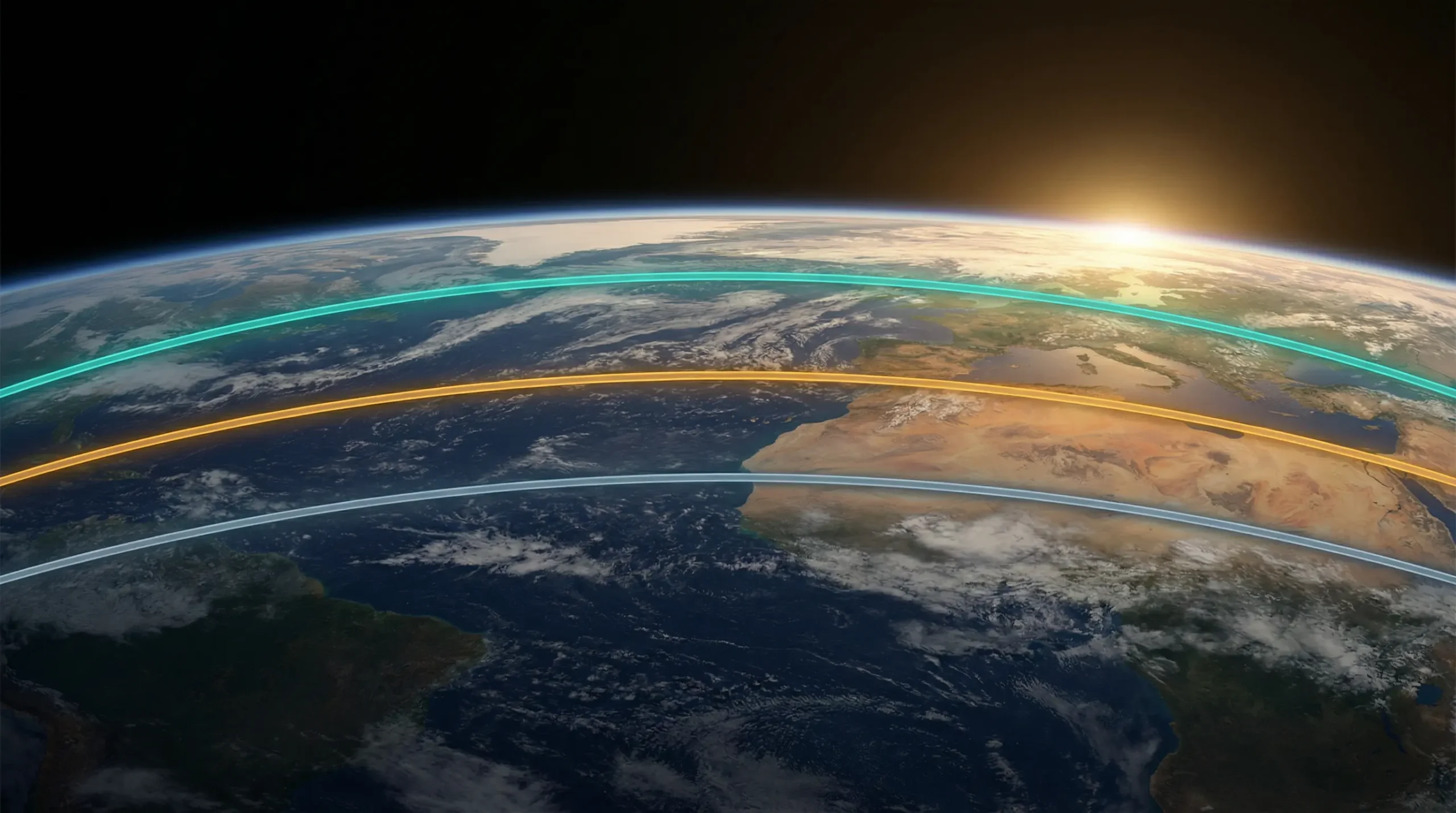
5G NTN can be deployed using different satellite orbital regimes, each with distinct characteristics and trade-offs. Orbit altitude is the single factor that shapes almost every engineering decision that follows.
- Low Earth Orbit (LEO), typically 550 to 1,200 km. Low latency and strong link budgets. The satellite moves fast, around 7.5 km/s relative to the ground, so it is only in view for a few minutes and the connection has to be handed from one satellite to the next.
- Medium Earth Orbit (MEO), roughly 8,000 to 20,000 km. A middle ground: moderate latency, moderate Doppler, and longer visibility than LEO.
- Geostationary Orbit (GEO), at 35,786 km. The satellite appears fixed in the sky, giving very wide coverage and terrestrial-like cell planning. The trade-off is delay: a signal takes around 120 ms to travel from device to satellite to ground, about 240 ms for the round trip.
The same 3GPP-defined mechanisms have to work across all of these orbits, but the right settings are completely different for each one. A timing approach tuned for GEO’s slow, steady geometry is unsuitable for LEO’s fast-changing distance. A Doppler correction built for LEO is unnecessary for GEO. The standard covers all of them within one framework. Stable operation comes from matching that framework to the specific constellation.
Latency, the time required for a signal to travel through the network, remains a key performance consideration across all orbital regimes and continues to influence architectural choices in 5G NTN design.
Efectos Doppler y movimiento de los satélites
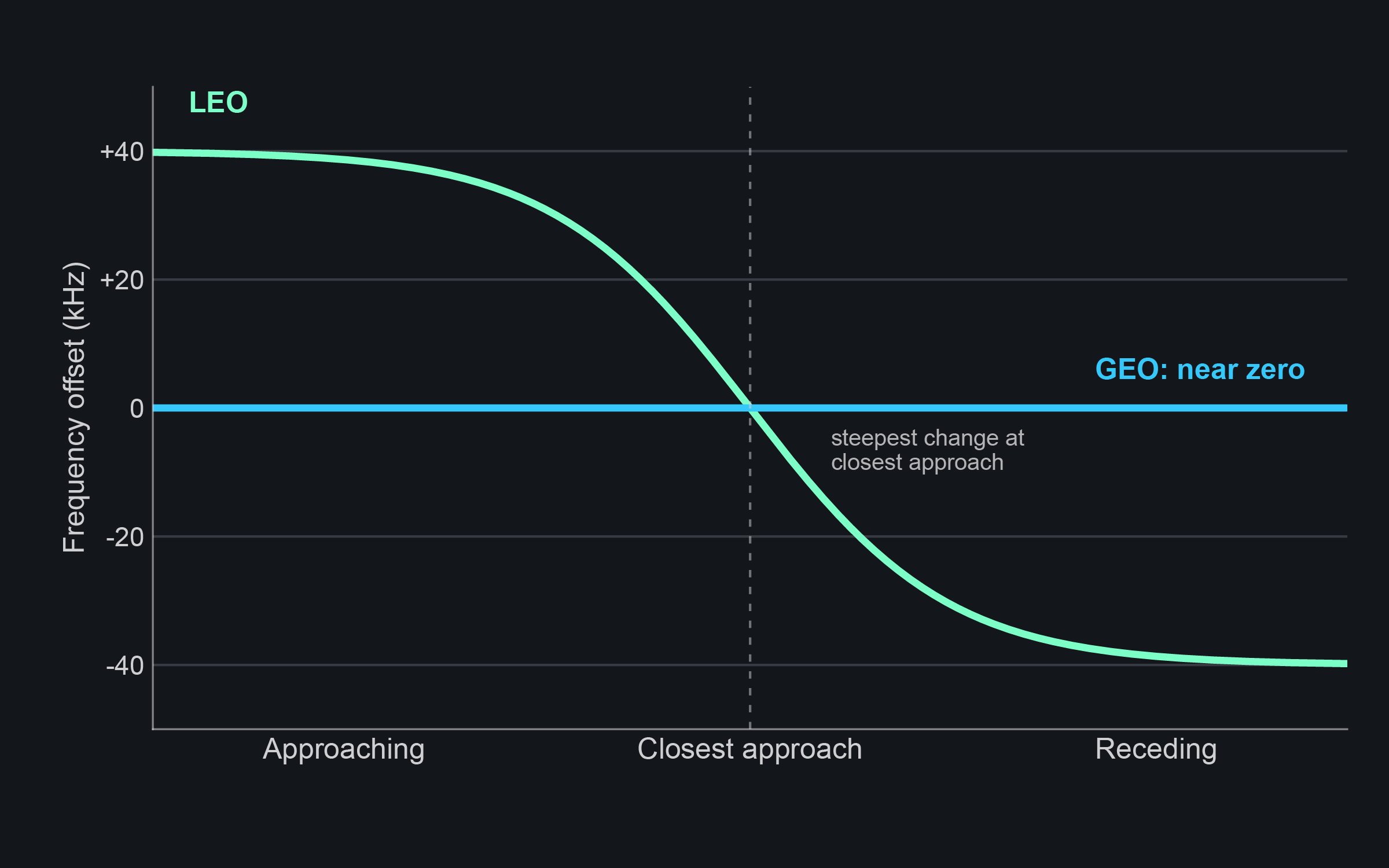
When a satellite moves quickly relative to a device on the ground, the frequency of the radio signal shifts. This is the Doppler effect, and if it is left uncorrected it degrades radio performance. How big a problem it is depends almost entirely on the orbit.
In LEO, the satellite moves at around 7.5 km/s, which at typical 5G frequencies produces a frequency shift of tens of kilohertz that also changes quickly as the satellite crosses the sky. The 5G New Radio (NR) waveform tolerates a small amount of this, but beyond that the signal becomes hard to recover. 3GPP Release 17 requires the device to correct for the shift before transmitting, using its own satellite-positioning (GNSS) fix and the satellite’s broadcast orbital data to calculate it. What the standard does not specify is how the device should predict the shift between updates, or how it should handle a satellite that maneuvers or drifts from its predicted path. Those choices are left to the implementation.
In GEO, the satellite is effectively stationary relative to the ground, so Doppler from orbital motion is negligible. The small residual frequency error comes from hardware, mainly oscillator drift and minor station-keeping. Correction is simple and stays valid for hours.
This is why a system validated only against GEO-like conditions can look stable in the lab and then fail over LEO, where the frequency environment changes second by second. LEO and GEO call for fundamentally different correction approaches. LEO is dominated by orbital motion with a high rate of change. GEO is dominated by hardware imperfections that need only near-static correction.
¿Cuáles son los principales retos del 5G para los satélites?
La prestación de servicios 5G por satélite introduce limitaciones que no existen en las redes terrestres. Varios retos siguen siendo fundamentales para el diseño 5G NTN :
- Line-of-sight requirements between satellites and user devices to close the link budget.
- Ventanas de visibilidad limitadas en LEO debido al movimiento continuo de los satélites.
- Frequent satellite reselection, requiring user equipment to switch satellites without service interruption.
- El retraso de propagación, especialmente en GEO , afecta a las aplicaciones sensibles a la latencia.
- Increased path loss, driven by long transmission distances.
These challenges are well understood at the standards level. 3GPP defines mechanisms for each of them. The harder question, and the one that separates a system that passes testing from one that runs reliably, is how those mechanisms are tuned for a specific orbit. Two examples show why.
Timing over satellite links
Every mobile network has to account for the time a signal takes to travel between the device and the network, and it adjusts transmission timing to compensate. This adjustment is called timing advance. On the ground the delay is small and changes slowly. Over a satellite it is far larger, and over a fast-moving LEO satellite it changes constantly.
For GEO, the delay is large but steady. The main risk is that standard network timers, the ones handling retransmissions, acknowledgements, and link-failure detection (RLC, HARQ, and RLF in 3GPP terms), were written assuming terrestrial round-trip times. If they are not reconfigured for the roughly 240 ms satellite round trip, a perfectly healthy connection can look like a failing one, triggering needless retransmissions or even a dropped link.
For LEO, the timing target keeps moving. Over a five to ten minute pass, the distance between device and satellite can change by more than a thousand kilometers. Release 17 has the device calculate and apply its own timing correction in advance, using its satellite-positioning fix and the satellite’s broadcast orbital data. The standard requires this to happen. It does not say how often the device must recalculate, or how it should predict ahead between updates. Weak choices here cause access attempts and uplink transmissions to arrive outside their expected window, which shows up as failed connections and error spikes.
Keeping a connection as satellites move
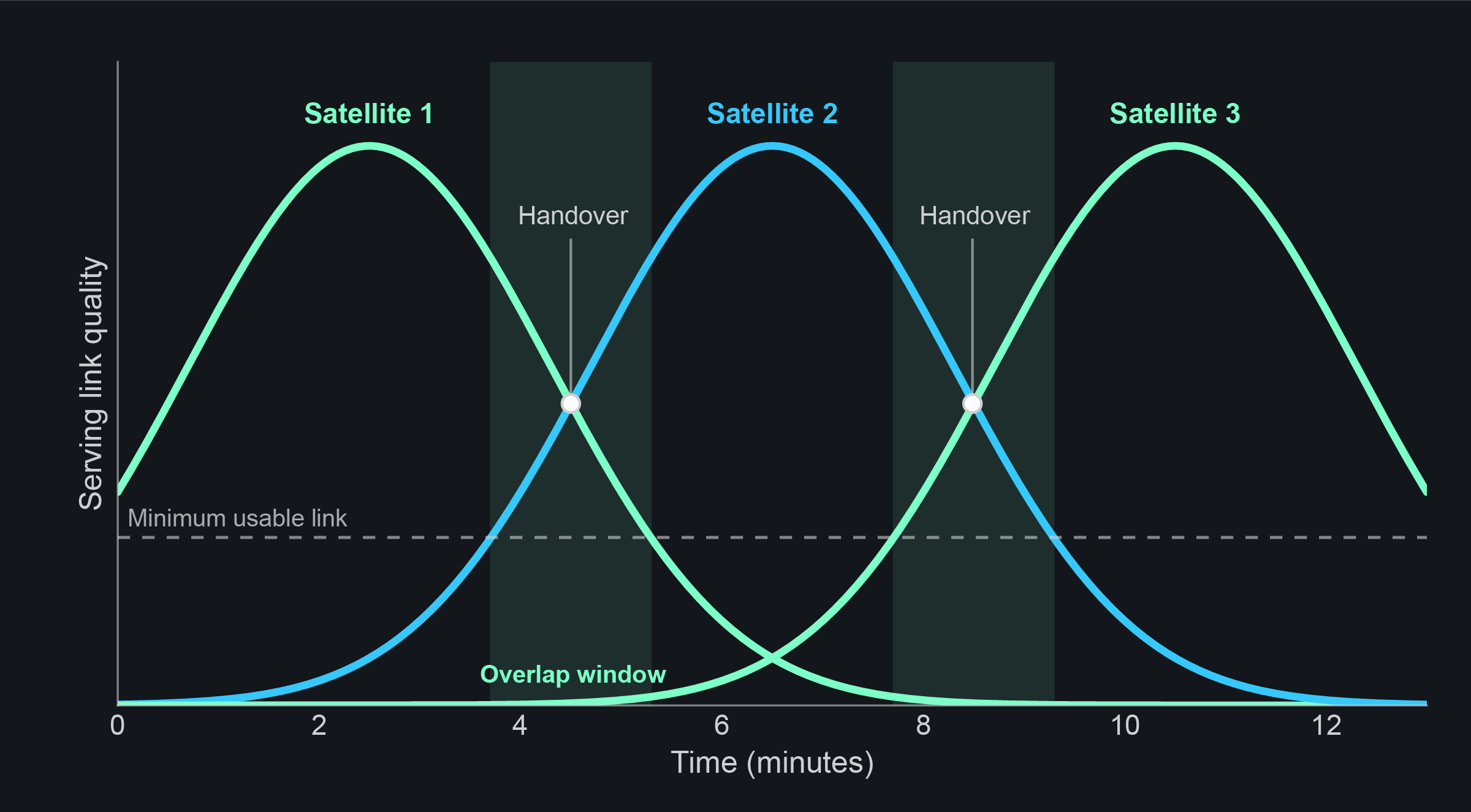
A LEO satellite is overhead for only a few minutes, and a single beam may serve a device for even less. To keep a session alive, the network has to hand the device from one satellite or beam to the next before the current link weakens too far.
3GPP provides the framework for this. The device measures signal strength and quality, and the network decides when to switch based on those measurements and on broadcast information about where the satellites are. What the standard does not define is the policy: how early to trigger the switch given how little visibility time is left, and how to combine signal measurements with knowledge of the satellite’s path.
The failure modes are predictable. Triggers carried over from terrestrial networks fire too late, after the link has already degraded, causing drops. Set too aggressively, the connection bounces back and forth between satellites. Both happen in fully standards-compliant systems. And because handovers now occur every few minutes instead of every few hours, each one also has to preserve the session’s state, its security context and buffered data, or the user feels the interruption.
Why meeting the 3GPP standard is not the same as deploying
Release 17 defined these mechanisms. Release 18 extended them with further mobility and coverage improvements. Both define what each mechanism does. Neither defines how to calibrate it for a specific orbit. That calibration, the distance between a system that conforms to the standard and one that stays stable in service, is filled by engineering choices that can only be checked against realistic orbital conditions.
In test environments that reproduce orbit-specific behavior, time-varying delay, Doppler that follows a real LEO pass, and handovers constrained by actual visibility windows, problems appear that never show up in static, single-point conformance testing. Timing that holds at one elevation angle fails at another. Doppler correction that holds mid-pass diverges near the horizon. Handover settings that behave at one orbital inclination trigger late at another.
Surfacing those behaviors before deployment is the focus of Gatehouse Satcom’s validation work. The practical point for any NTN programme is the same: validation has to model orbit-specific dynamics, not just confirm that the protocol behaves at a nominal operating point. A test campaign that skips those conditions will not catch the instabilities that appear in the field. That is where late integration surprises come from, and the cost is usually measured in schedule, not in engineering hours.
5G NTN el panorama de la conectividad en 2026
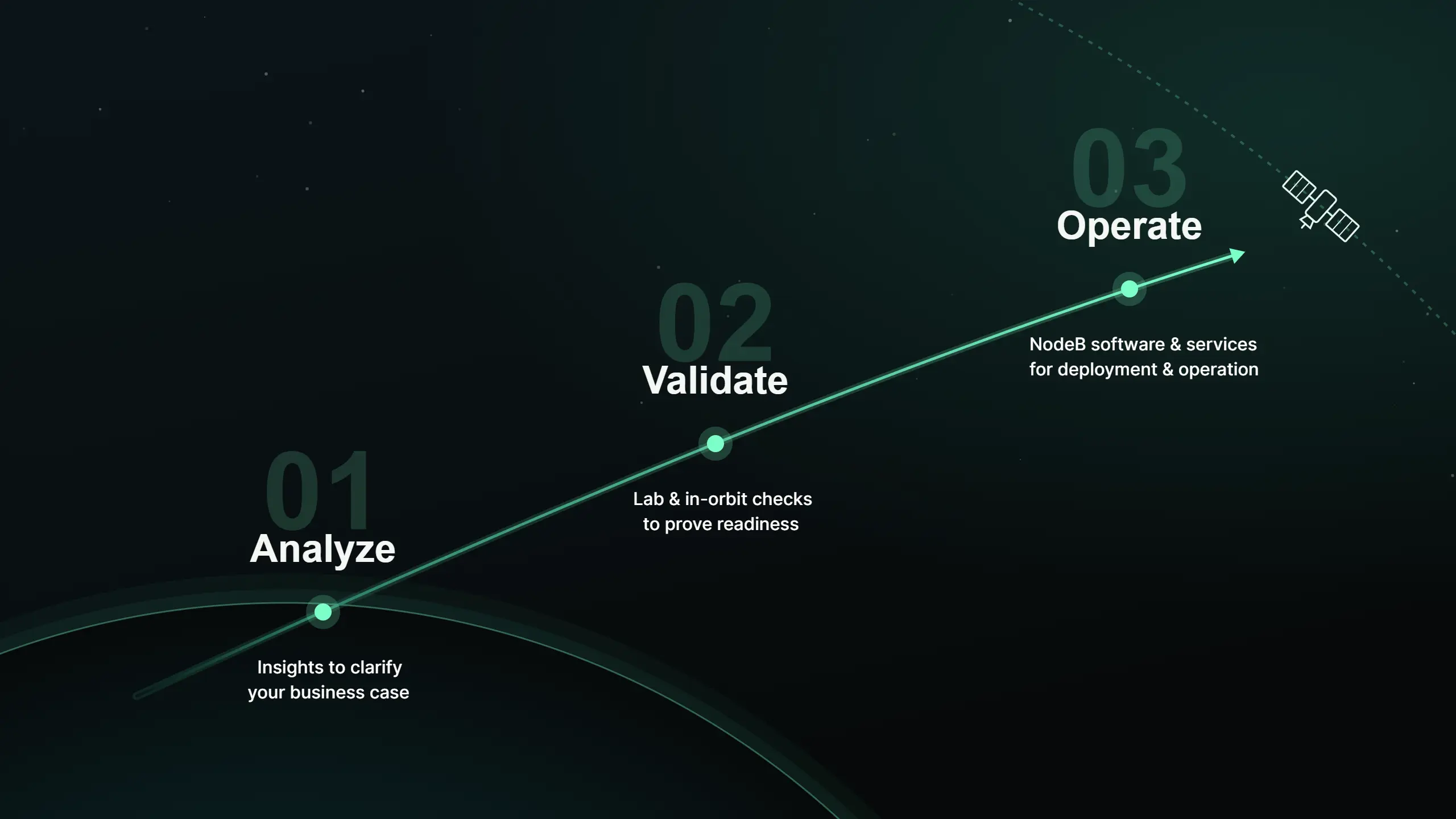
By 2026, 5G NTN is past the question of whether it works. The technical foundations are defined, and real-world testing is refining performance and operational models. The open work is less about the standard itself and more about turning standards-based implementations into networks that run predictably over real constellations.
For teams moving from validation toward deployment, that gap is worth understanding early. Gatehouse Satcom’s 5G NTN validation and feasibility work focuses on exactly this transition, from a standards-compliant implementation to one proven against the orbital conditions it will actually meet in service.