La finalisation de 3GPPversion 17 a fait de l’ NB-IoT 5G par satellite et de la connectivité directe aux appareils une réalité. L’intérêt croissant pour les services 5G par satellite impose de nouvelles exigences à l’architecture du système d’ NB-IoT , qui doit assurer une couverture réseau ininterrompue sur de vastes zones géographiques tout en relevant les défis et en surmontant les contraintes actuels en matière de connectivité à l’échelle mondiale. Svend Holme Sørensen, directeur produit chez GateHouse SatCom, et Henrik Krogh Møller, architecte logiciel senior, présentent l’architecture et les éléments système nécessaires au développement des systèmes NTN (NB-IoT ) 5G, aujourd’hui et à l’avenir.
GateHouse SatCom développe des systèmes de communication par satellite de pointe depuis plus de 20 ans. Aujourd’hui, cette entreprise spécialisée exclusivement dans les logiciels et le développement de formes d’onde met son expertise au service de plusieurs marchés commerciaux et militaires. Elle est récemment devenue membre individuel de l’ETSI et participe activement à la version 17 révolutionnaire de l’ 3GPP, visant à normaliser les spécifications de l’ NB-IoT 5G directement vers les appareils.
Avec l'intégration du NTN dans les 3GPP , on s'attend à ce que la prochaine génération d'appareils IoT n'ait besoin que d'une mise à jour avec un chipset compatible NTN pour pouvoir passer d'un réseau mobile à un réseau satellite.
« La capacité de service 5G direct vers l'appareil est une étape importante pour la connectivité par satellite et offre de nombreuses opportunités intéressantes », déclare Svend Holme Sørensen, directeur produit GateHouse Satcom, avant de poursuivre :
« Auparavant, nous considérions la connectivité par satellite à travers le prisme des grands terminaux et des antennes imposantes conçus uniquement pour les communications par satellite. Les appareils que nous contribuons à développer aujourd'hui peuvent fonctionner avec des services terrestres et satellitaires, ce qui permet une utilisation généralisée et ininterrompue des appareils 5G terrestres et satellitaires dans de nombreux secteurs, même dans des régions réputées difficiles à couvrir. »
Les industries peuvent mettre en œuvre des services 5G par satellite dans des appareils également conçus pour les services terrestres en utilisant les capacités de l'architecture système NB-IoT .
«Nous voyons de nombreux appareils qui ne prennent en charge que la connectivité terrestre, mais qui ont un énorme potentiel d'adaptabilité NB-IoT . Le secteur de la logistique pourrait enfin obtenir la visibilité de bout en bout tant convoitée. Le secteur agricole pourrait disposer de traceurs GPS alimentés par satellite pour suivre l'activité du bétail. De même, les secteurs agricoles pourraient adopter des enregistreurs de température et d'humidité sans fil alimentés par satellite. Les possibilités sont infinies».
Cependant, Svend précise que le développement d’une architecture de système « NB-IoT » 5G permettant d’assurer une interopérabilité et une connectivité optimales entre les réseaux terrestres, les réseaux non terrestres et des millions d’appareils connectés (IoT) n’est pas sans poser de défis.
Rattraper son retard et s'adapter
3GPP NB-IoT avait initialement conçu ce système pour une utilisation terrestre dans le cadre de ses spécifications de la version 13, l'architecture du système ne prévoyant aucune signalisation par satellite.
Un NB-IoT se connecte directement au réseau via une interface Uu, atteignant une tour NodeB terrestre dans le réseau cellulaire. Lorsque NB-IoT envoie finalement des données à Internet, celles-ci transitent par le cœur de réseau paquet, en l'occurrence un EPC 4G. Cette architecture de système NB-IoT a servi de base à l'exploration de la connectivité NTN par satellite via les études préliminaires de la version 16 et les spécifications de la version 17.
« Les satellites jouent désormais un rôle essentiel dans l’adaptation de l’architecture du système NTN d’ NB-IoT aux réseaux terrestres existants. Au lieu qu’un appareil se connecte directement à une antenne-relais NodeB, sa liaison de service transite d’abord par un satellite, qui achemine le signal via une liaison d’alimentation vers un NodeB NTN au sol, lui-même connecté à l’EPC de l’opérateur satellite », explique Henrik Krogh Møller, architecte logiciel senior chez GateHouse SatCom.
La version 17 se concentre actuellement sur le mode transparent (voir fig. 1), dans lequel le nœud B est situé au sol. Le mode régénératif, qui sera étudié dans la version 18 puis à nouveau dans la version 19, vise à implémenter les nœuds B en tant que charges utiles à bord des satellites. Cette implémentation nécessitera des adaptations supplémentaires au niveau des appareils, des nœuds B et de l’EPC afin d’augmenter la vitesse de connexion et l’efficacité.
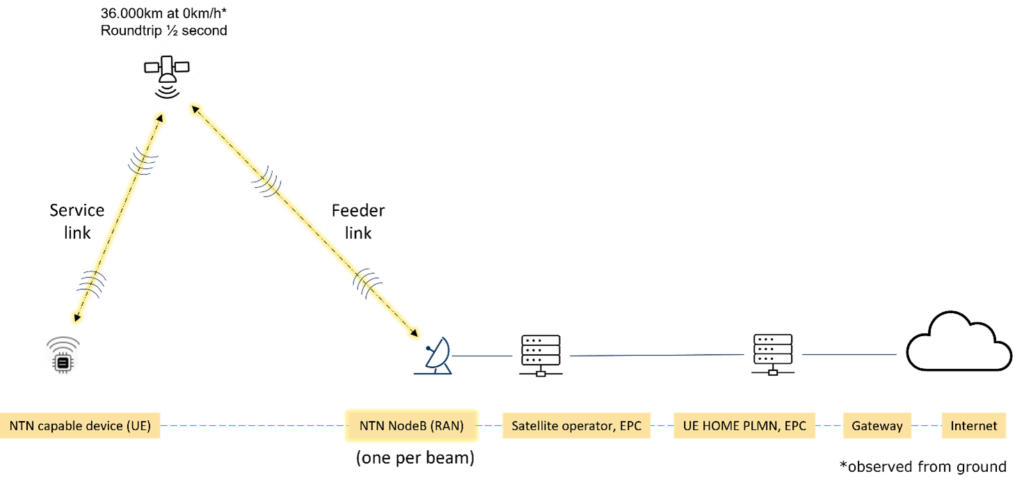
Contraintes liées au service et aux liaisons d'alimentation
Il existe plusieurs difficultés liées aux liaisons de service et d'alimentation, notamment l'effet Doppler, le retard, les variations du signal et l'atténuation en propagation, qui dépendent toutes du satellite, de son angle d'élévation et de sa position dans le ciel.
Les satellites en orbite haute ( GEO ) fonctionnant à 36 000 km au-dessus du sol subiront des pertes de trajet nettement plus importantes que les satellites en orbite basse LEO (NGSO), situés par exemple à 600 km. Le retard du signal et l'effet Doppler lié aux satellites NGSO varieront également à mesure que le satellite se rapproche ou s'éloigne.
« La couche physique de l'appareil nécessite une adaptation rendue possible par les informations de positionnement GNSS afin de pallier ces difficultés. Dans le cadre de cette compensation, les satellites diffuseront leurs informations de position et de synchronisation », explique Henrik.
Un autre domaine d'intérêt concerne la manière dont les satellites gèrent des millions d'appareils IoT en mouvement constant, couvrent simultanément plusieurs zones de suivi en peu de temps et restent connectés aux réseaux NGSO :
« Les terminaux reçoivent une liste d’identifiants de zones de suivi, à l’instar des réseaux terrestres. Le NodeB diffuse son identifiant de suivi actuel ainsi qu’une liste des zones de suivi en service, qui évolue au fil du temps en fonction des déplacements des satellites. Cette liste sert de référence pour la radiomessagerie des terminaux, et seuls les terminaux dont les identifiants figurent à la fois dans les deux listes peuvent être contactés. Les terminaux peuvent transmettre leur position au réseau, ce qui permet une optimisation du service. »
Une fréquence plus élevée implique des défis plus importants en matière de transmission des signaux
Les spécifications NTN de la version 17 d’ NB-IoT , entreront en vigueur sur les fréquences de la bande S, qui s’étendent de 2 à 4 gigahertz (GHz), franchissant ainsi les limites conventionnelles des bandes ultra-hautes fréquences (UHF) et très hautes fréquences (SHF) à 3 GHz. Les secteurs de l’aviation, du transport maritime et de l’espace utilisent la bande S pour ses capacités optimisées de communication bidirectionnelle et de diffusion de contenu destinées aux réseaux mobiles et aux appareils portables.
Cependant, Svend précise que les fréquences plus élevées « posent des défis techniques majeurs », qui affectent la qualité, l’efficacité et la fiabilité des services 5G par satellite à l’échelle mondiale. Ce défi concerne principalement les satellites GEO en orbite haute fonctionnant à des fréquences supérieures à 6 GHz. «Des discussions sont en cours entre l’ 3GPP e et l’Union internationale des télécommunications (UIT)afin d’aborder les défis liés au spectre des fréquences et leur impact sur la connectivité par satellite NB-IoT . Malheureusement, ces discussions n’ont pas encore abouti, mais nous pensons qu’elles aboutiront à l’avenir. »